
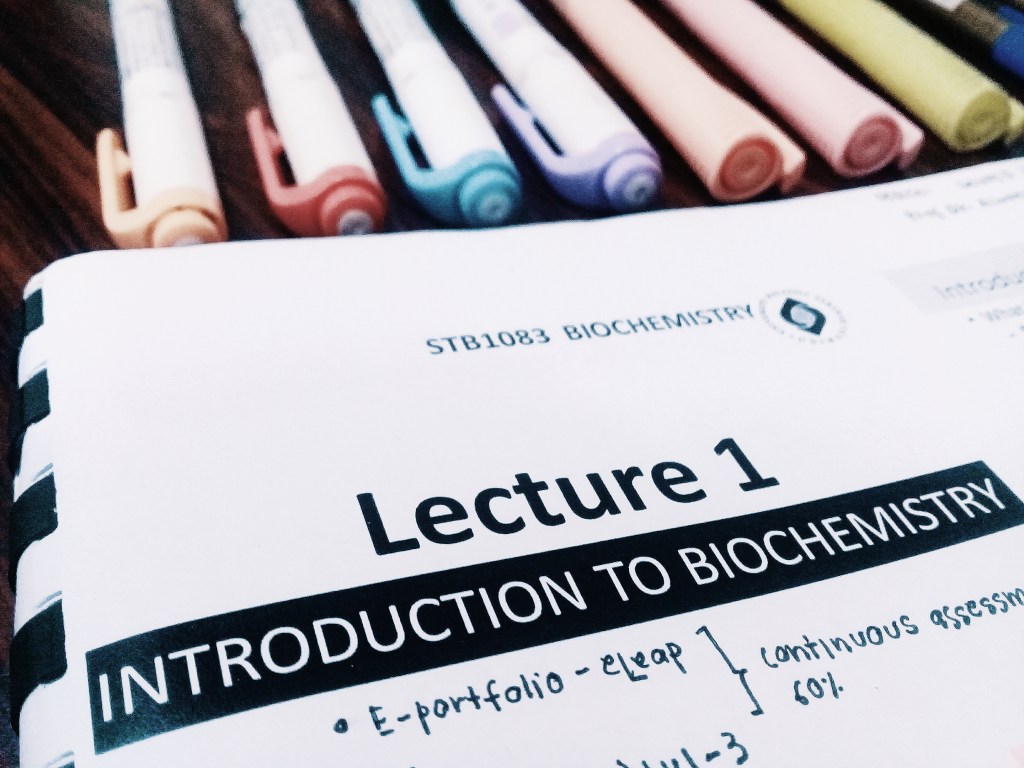
Did you know that the human body is made of 6 major element which are oxygen, carbon, hydrogen, nitrogen, calcium and phosphorus? These elements contribute to approximately 99% of the human body. As a student taking a chemistry course, this is an interesting field as finally I can relate chemical principle with something connected to me.
Biochemistry is a field that practice the principles and language of chemistry in biology at a molecular level. It is a demanding field need by the real world especially for medicine and clinical purposes, agricultural and industrial field. The three areas of study in biochemistry is conformational; the structure and 3D arrangements of biomolecules, metabolism; the biological pathways and lastly, informational; language of communication inside and between cells.
The molecules that made the human body (or other living organism) as it is is coined as biomolecules. Biomolecule is another term of organic compound where the molecule must have carbon atom to be classified as one. Biomolecules can be classified as biological micromolecules and biological macromolecules. Macromolecule is derived from micromolecule. Biomolecules have the tendency to cluster together forming a complex structures. For instance, virus is made of DNA or RNA strand wrapped in a protein package.
Explaining the stages from biomolecules until cell are created, there are four level involved. First, micromolecules create macromolecules. Next, macromolecules cluster to form supramolecular complex. After that, this supramolecular complex form a molecular cell. Taking mitochondrion as an example, the outer and inner membrane are made of phospolipid bilayer and protein that cluster together forming a supramolecular complex that then form a cell with function. Mitochondrion is responsible in generating adenosine triphospate (ATP) as a source of chemical energy of the molecular cell.
 E U N E I R O P H R E N I A