
Generally, lipid is a group of compounds that is not soluble or partially soluble in water. Together with protein and carbohydrate, it is a major constituent in organisms and possess vital functions; energy stores, component of biological membranes and serves as signalling molecules. the classification of lipids is as illustrated in Figure 1.
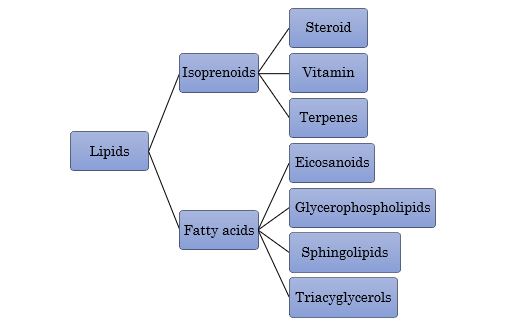
Fatty acids are hydrocarbon structures formed by four (C4) or more carbons attached to carboxyl group. Short, medium, long and very long chain-fatty acids are classified based on carbon number which are C4-C10, C12-C14, C16-C18 and C20 respectively. C16 and C18 are predominant in plant and animal respectively. Additionally, fatty acids can also be classified based on the degree of saturation. The key feature of saturated chain are molecules are packed tightly in rigid and organized. For example, laurate, myristate and palmitate. Whilst, unsaturated chain is the opposite; ununiformly packed particles that can move. For instance, oleate, linoleate and palmitoleate.
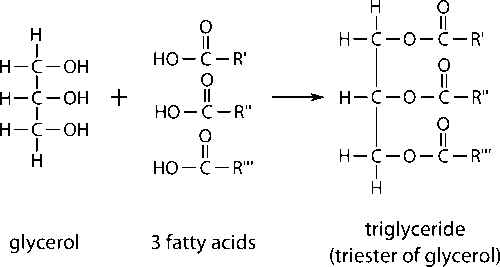
Triacylglycerols (TAG) is an ester derived from glycerol and three fatty acids as illustrated in Figure 2. Not only serves as energy storage, TAG or commonly known as body fat is use as body insulation in human and animal. Chemically, its melting temperature reflect their composition. As the chain length increase, molecular weight also increases resulting in increasing melting point. Besides, saturated chain has higher melting point than unsaturated chain.
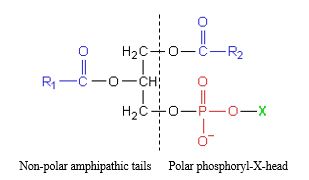
Glycerophospholipids are major component of biological membranes, i.e.: lipid bilayer. They are amphipathic molecules where glycerol and phosphate act as the polar end while hydrocarbon chains act as the nonpolar end.
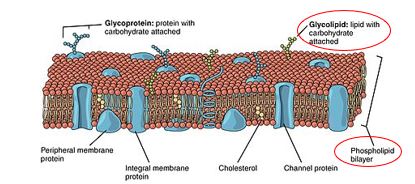
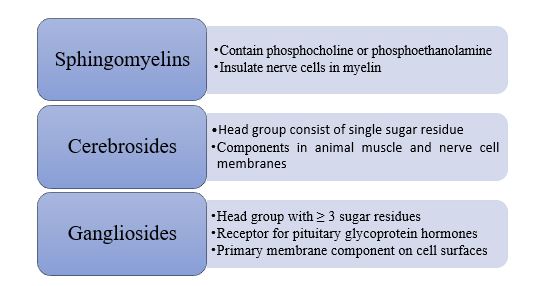
Sphingolipids is another type of phospholipid besides glycerophospholipids. It is also an amphipathic molecule and a major membrane component. The hydrophobic region consists of sphingoid long chain base (aliphatic chain with attached hydroxyl group) with fatty acid chain attached by amide bond at carbon 2. The hydrophilic region has phosphate groups, sugar residues and hydroxyl groups. Sphingomyelins, cerebrosides and gangliosides are the examples of sphingolipids.
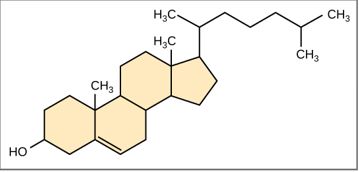
Steroids have a fused ring structure which do not resemble the other lipids. Despite that, they are grouped as lipid because of their hydrophobic property. All steroids have four linked carbon rings and majority has a short tail. Steroids that have the -OH group are classified as sterols. Cholesterol is one of the examples of steroid. It is common in animal which function as salt balancer, involve in metabolic functions and sexual functions.
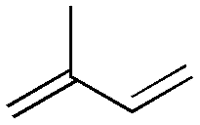
Terpenes are non-saponifiable lipids that is derived biosynthetically from units of isoprene. They are categorized based on the number of isoprene units; monoterpenes, sesquiterpenes, diterpenes, sesterterpenes and triterpenes for 2,3,4,5 and 6 isoprene units respectively. Isopentenyl pyrophosphate (IPP) and Dimethyl pyrophosphate (DMAPP) are the examples of terpenes. Terpenes are the major biosynthetic building blocks within living creature. Some terpenes are used to attract pollinating insects or providing defence mechanism by attracting animals, such as mites. In plants, they are common constituent of essential oils which employ wide range of natural flavour additives for food and as fragrance in perfumery.
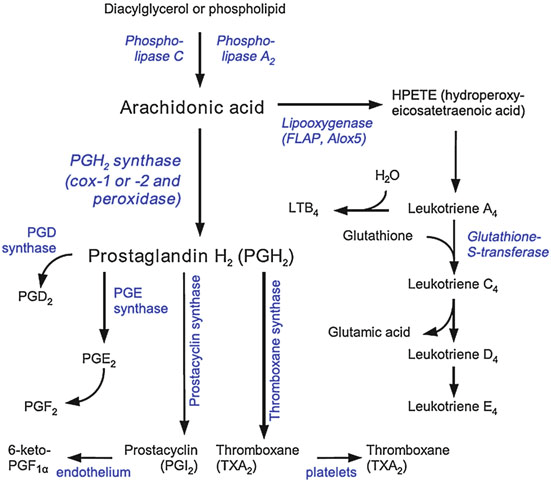
Eicosanoids are signalling molecules made by oxidation of arachidonic acid (or other polyunsaturated fatty acids that have 20 carbon units like arachidonic acid). Arachidonic acid is a polyunsaturated fatty acid and a type of omega-6 fatty acids. They can be either omega-6 fatty acids derived, or omega-3 fatty acids derived. The synthesized eicosanoids are not stored in body, instead they are directly used on site. Eicosanoids have complex control over bodily system such as inflammation and immunity. They also act as messenger in the central nervous system. They have roles towards the production of pain and fever, regulation of blood pressure, blood coagulation and reproduction. Eicosanoids are further classified under subfamilies; prostaglandins, prostacyclin, thromboxane and leukotrienes.
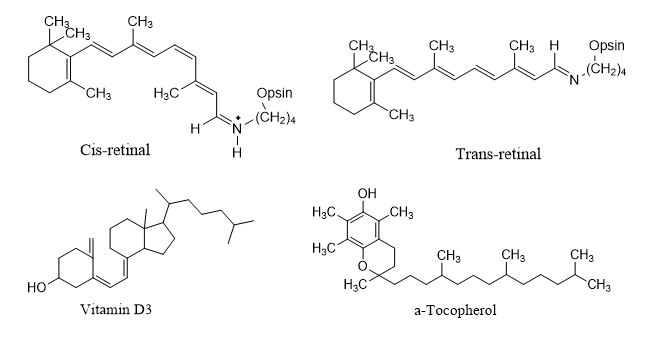
The four lipid soluble vitamins present in diet are vitamin A, D, E and K. Vitamin is a group of unsaturated organic compound consist of retinol, retinoic acid, provitamin A carotenoids and beta-carotene. Vitamin A plays an important role in the visual cycle of rod cell. Retinal (a vitamin A aldehyde) is the active molecules of this cycle. It forms an imine with an -NH2 group of the protein opsin to form visual pigment called rhodopsin. The primary chemical event of vision in rod cells is absorption of light by rhodopsin followed by isomerization of the 11-cis double bond to the 11-trans double bond. Next, vitamin D is a group of structurally related compounds that play a role in the regulation of calcium and phosphorus metabolism. Vitamin D3 is the most abundant form in the circulatory system. Vitamin E is a group of structurally related compounds which function as antioxidant. α-tocopherol is the most active compound of vitamin E. they trap HOO• and ROO• radicals formed as a result of oxidation by oxygen of unsaturated hydrocarbon chains in membrane phospholipids.
 E U N E I R O P H R E N I A